🧬 Do you know what an epigenetic clock is?
Throughout an organism’s life, epigenetic marks (such as DNA methylation) change in predictable ways. By analysing these marks, we can infer the chronological age of an individual. These predictive models, called epigenetic clocks, have been built across the tree of life: in humans, mammals, birds, reptiles, fish, and even invertebrates. But they always involved cross-fertilizing organisms with high genetic diversity.
With my PhD student Justine Bélik, we’ve just published the first epigenetic clock in a self-fertilizing vertebrate: the mangrove rivulus (Kryptolebias marmoratus), the only known vertebrate capable of self-fertilization.
🔬 Why does it matter?
Because in all other species, DNA methylation is entangled with genetic variation, making it difficult to isolate what is purely epigenetic. The mangrove rivulus, with its naturally very low genetic diversity, allows us to study DNA methylation changes without the confounding effects of genetic variation. This gives us a unique window into the specific roles of epigenetics in aging.
🧠 A first look at epigenetic aging in the vertebrate brain
This is also the first epigenetic clock built on brain tissue, offering new insights into how epigenetic mechanisms drive aging in this organ, and opening the door to a better understanding of brain aging in vertebrates.
📊 The results
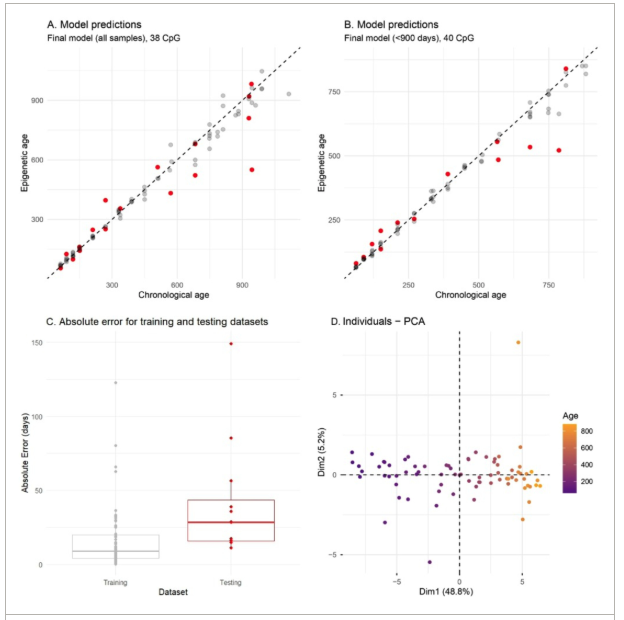
Justine used reduced representation bisulfite sequencing on 90 brain samples from fish aged 60 to 1,100 days. After modelling, she selected 40 CpG sites that consistently predict chronological age with remarkable accuracy (R² > 0.96, mean absolute error of only 28.7 days).
🔭 What’s next?
We plan to apply this clock to wild populations to compare chronological and biological age under natural conditions, linking molecular age to environmental factors such as pollution and climate variation. We also aim to develop a similar clock on fin tissue for non-invasive use in the field.
🎉 Huge congratulations to Justine for her first published paper!
📖 The article is available in open access in Ecology and Evolution:
https://onlinelibrary.wiley.com/doi/10.1002/ece3.73881
https://onlinelibrary.wiley.com/doi/10.1002/ece3.73881